Cash App works by linking your bank account or debit card to a free mobile wallet run by Block, Inc. You send and receive money through a username called a $cashtag, spend your balance with the Cash App Card, and manage savings, stocks, Bitcoin, and direct deposits inside the same app. Transfers between Cash App users arrive instantly.
Cash App pairs its identity as Block’s payment platform with a simple money flow: payments move between people instantly, funds come in from banks, cards, checks, or physical cash, and cash out at the speed you choose. Verification level sets your limits, fees stay confined to a short list of optional actions, the Cash App Card turns the balance into everyday spending money, and the wider feature set reaches into saving, investing, and borrowing. Age rules decide who can open an account, layered protections handle safety, and the app competes directly with Venmo, PayPal, and Zelle.
What is Cash App?
Cash App is a mobile payment and financial services platform made by Block, Inc., the company behind Square. It launched in 2013 as a simple way to send money between friends and now covers spending, saving, investing, and tax filing in one app. Cash App describes itself as a financial platform, not a bank; banking services run through its partner banks, as Block states across its products. Every account gets a unique $cashtag that works like an account name for payments.
How do you send and receive money on Cash App?
You send money on Cash App by entering an amount and choosing a recipient by $cashtag, phone number, or email, then confirming with your PIN. Payments between Cash App users land instantly in the recipient’s balance. Receiving works in reverse: tap Request, pick a contact, and the app notifies them to pay you. The full walkthrough, including group payments and what to do when a payment fails, lives in our guide to sending money on Cash App.

How do you add money to Cash App?
To add money to Cash App, you link a bank account or debit card and load your balance from the Add Cash tab. Three other funding routes exist: direct deposit of your paycheck, scanning paper checks with your phone camera, and depositing physical cash at participating retailers for a $1 fee, covered step by step in adding money to your Cash App card and the paper money option.
How do you cash out of Cash App?
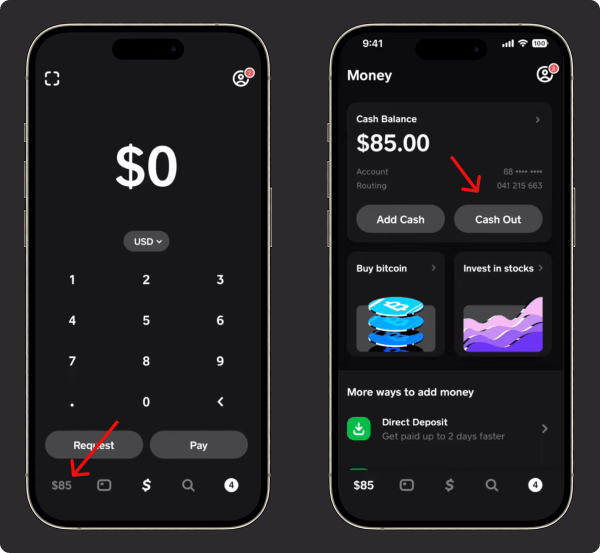
To cash out of Cash App, you move your balance to a linked bank account from the Money tab. A standard transfer is free and settles in one to three business days. An Instant transfer to your debit card costs 0.5% to 1.75% of the amount, with a $0.25 minimum. ATM withdrawals with the Cash App Card are the third route, detailed in withdrawing money from Cash App.
What are the Cash App limits?
Cash App limits depend on identity verification. Unverified accounts can send up to $250 per 7 days and receive up to $1,000 per 30 days. Verifying with your name, date of birth, and SSN raises sending to $7,500 per week and makes receiving unlimited. Separate caps apply to the Cash App Card, ATM withdrawals, and deposits; every figure sits in our full guide to Cash App limits.
Business accounts follow the same sending and receiving tiers, but Cash App keeps 2.6% + $0.15 of each payment you receive (3% for Tap to Pay), which we break down in our guide to Cash App business account limits and fees.
What fees does Cash App charge?
Cash App is free for its core actions and charges fees only for speed, credit, and cash handling:
| Action | Fee |
|---|---|
| Creating an account, sending and receiving from a bank, debit card, or balance | Free |
| Standard transfer to your bank (1 to 3 business days) | Free |
| Instant transfer to a debit card | 0.5% to 1.75%, minimum $0.25 |
| Sending with a linked credit card | 3% |
| Out-of-network ATM withdrawal | $2.50 |
| Paper money deposit at a retailer | $1 |
| Foreign transactions | 3%, waived the following month for Cash Card users who spend $500 or more or receive $300 or more in qualifying activity |
All fee figures come from Cash App’s own overview page, checked on 26 July 2026. Fifteen separate Cash App fees exist in 2026, and each has a free route around it except credit-card sends and business receiving.
What is the Cash App Card?
The Cash App Card is a free, customizable Visa debit card that spends your Cash App balance anywhere Visa is accepted. It connects to Offers inside the app for instant discounts at selected merchants, works in Apple Pay and Google Pay wallets, and carries its own spending and ATM caps. Ordering takes a few taps, covered in ordering a new Cash App Card.

What other features does Cash App offer?
Cash App bundles four groups of features beyond payments, and each one stays optional.
Savings
A savings balance sits alongside your spending balance and earns interest, with the best rate reserved for customers who direct deposit. Setting savings goals and moving money in and out is free.
Investing in stocks and Bitcoin
You can buy stocks and Bitcoin from as little as $1 directly from your balance. Bitcoin trading requires full identity verification, and prices carry a volatility-based margin, so check the in-app rate before you buy.
Direct deposit, checks, and taxes
Cash App accepts payroll direct deposit and mobile check deposits, which turns the balance into a light checking account. At tax season, Cash App Taxes files federal and state returns free inside the same login.
Afterpay and Borrow
Block owns Afterpay, so eligible purchases can be split into pay-over-time installments. Borrow offers short-term loans to eligible users, with the amount shown in the app; how it works and who qualifies is covered in borrowing money from Cash App.
Who can use Cash App?
Cash App is built for people in the United States, and account types scale by age. Adults 18 and over get full accounts. Teens from 13 to 17 use sponsored accounts with a parent or guardian’s approval, nd parents can open managed accounts for children aged 6 to 12 that the parent runs from their own app, both explained in Cash App family accounts and Cash App for minors. You can start without a Social Security number at reduced limits, per using Cash App without an SSN, and sellers can switch to a business account for customer payments.
Is Cash App safe to use?
Yes, Cash App is safe for everyday payments when you use its built-in protections, and the honest caveat is that it is not a bank. Your balance is eligible for FDIC pass-through insurance up to $250,000, coverage that flows through Cash App’s program banks to you if certain conditions are met, such as holding the Cash App Card. The app runs 24/7 fraud detection, real-time notifications, a card lock, a security lock for every payment, and identity verification. The real risk is people, not the platform: payments to strangers are hard to reverse, so treat requests promising free money as scams.
How does Cash App compare with Venmo, PayPal, and Zelle?
Cash App competes on features, and the differences show up in limits and use cases:
| App | Owner | Best for | Verified weekly sending |
|---|---|---|---|
| Cash App | Block, Inc. | Payments plus banking, investing, and taxes in one app | $7,500 per week |
| Venmo | PayPal, Inc. | Social payments between friends | $60,000 per week |
| PayPal | PayPal, Inc. | Online shopping and international payments | Varies by account |
| Zelle | Early Warning Services | Free bank-to-bank transfers | Set by your bank |
Venmo’s higher cap and social feed suit different habits, compared fully in how Venmo works, and moving money between the two apps is covered in transferring from Cash App to Venmo.
Key takeaways
- Cash App is Block, Inc.’s payment platform: send and receive by $cashtag, instantly between users.
- Core use is free; fees apply to instant transfers (0.5% to 1.75%), credit card sends (3%), and out-of-network ATMs ($2.50).
- Verification lifts limits from $250 per 7 days to $7,500 per week sending, with unlimited receiving.
- The Cash App Card, savings, stocks, Bitcoin, Afterpay, Borrow, and free tax filing make it more than a payment app.
- Balances carry FDIC pass-through coverage up to $250,000 through program banks when conditions are met.